Women’s health physiotherapy in Lahore
Leaking when you cough, a middle that still feels weak months after delivery, a back that has not been right since the C-section. Pregnancy, childbirth and hormonal change are behind most of it, and it gets treated quietly or not at all — usually because nobody said it was treatable. It is, and you will be seen by a female doctor in a private room.
- First assessment
- Rs 2,500 Follow-up Rs 2,000
- Every session
- 40–45 min One-to-one with a doctor
- At home
- Rs 3,000 Same fee across Lahore
- Referral
- Not needed Book directly
Is this you
Does any of this sound familiar?
- Leaking urine when you cough, sneeze, laugh or lift something
- Needing the toilet more urgently, or more often, than you used to
- A middle that still feels weak and unsupported months after delivery
- Lower back pain and stiffness that started after a C-section
- Not being able to get back to exercise without something feeling wrong
- Being told it is normal after having a baby, and left at that
What we work on
- Pelvic floor muscle strengthening
- The muscles that support the bladder and the pelvis. Pregnancy and delivery stretch them, and like any other muscle in the body they can be trained back.
- Urinary incontinence
- Leaking with a cough, a sneeze, a laugh or a lift. Very common after childbirth, rarely mentioned, and not something you are supposed to live with.
- Poor core strength
- The deep stomach muscles stop pulling their weight during pregnancy and often do not switch back on by themselves. It is why the middle feels soft and unreliable long after the bump has gone.
- Lower back and pelvic pain
- Pain and stiffness that started in pregnancy, after childbirth or after a C-section. A scar, a changed posture, a baby carried on the same hip every day, and a core that is no longer sharing the load with the back.
- Diastasis recti — abdominal separation
- The two halves of the stomach muscle separate to make room during pregnancy and do not always come back together afterwards. It is the reason a middle can still look and feel wrong long after the weight has gone, and it is measurable rather than a matter of opinion.
- Postpartum recovery and pain in pregnancy
- Rebuilding strength after childbirth, and the ordinary muscle and joint pain of being pregnant. You do not have to wait until after the birth to be treated — the exercises are chosen for the stage you are at.
You do not need to work out which of these it is before you come. That is what the first assessment is for.
How it works
What actually happens, in order.
The first appointment is mostly questions
What changed, when it started, what makes it worse, what you want back. Delivery and surgery details matter here, so bring anything your doctor gave you.
Then you are examined
Posture, how you move, and the strength of the pelvic floor and the abdominal muscles. This is what turns a description of the problem into something specific enough to treat and to measure again later.
Treatment built for you, not off a sheet
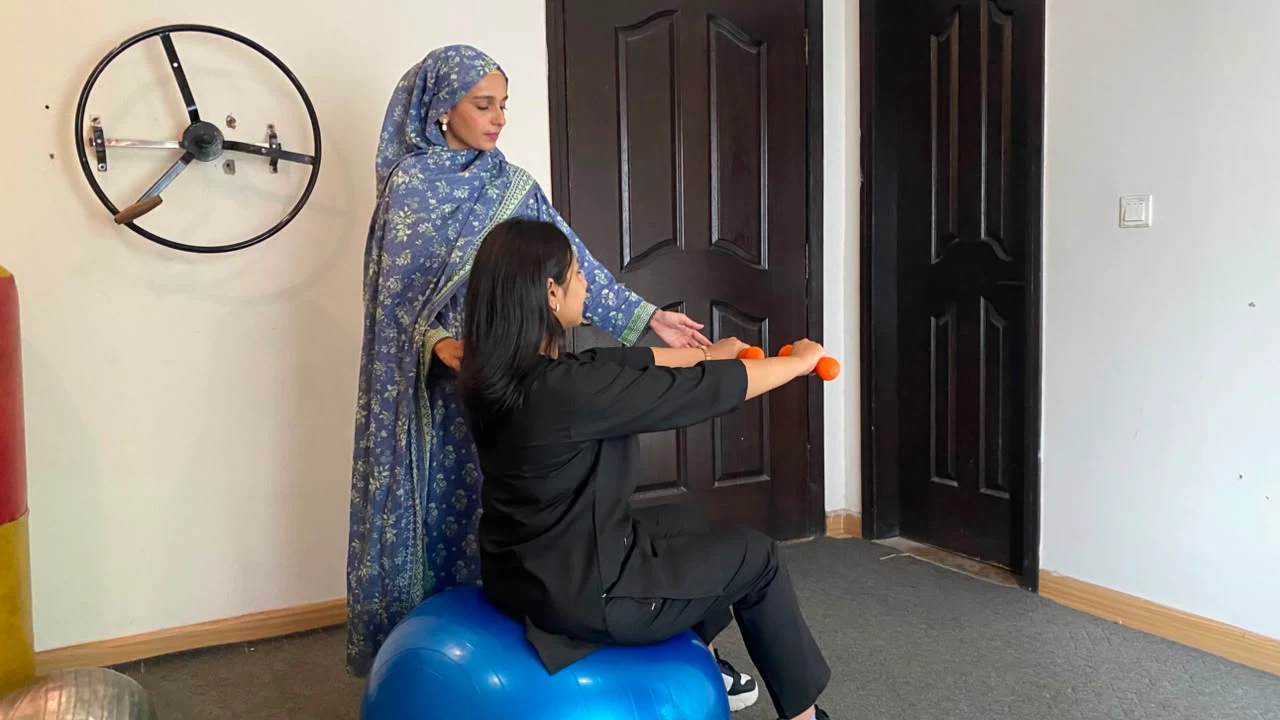
Pelvic floor training, exercises for the deep stomach muscles, and hands-on work for the lower back and the stiffness around a scar. Most women who have been told to "do their exercises" are squeezing the wrong muscles, so the contraction itself is taught here rather than handed over on a printout. Both doctors are manual therapists; the hands-on part is theirs.
A programme you do at home
A session is 40–45 min. What changes things is the few minutes a day in between, which is why you leave with something specific to do, the precautions that go with it, and a way to tell whether it is working.
See a doctor first if any of these apply.
Physiotherapy is not the right first step for all of this. Call us and we will tell you honestly, or go to your doctor first if:
- You have not yet had your post-delivery check-up
- Bleeding has restarted, or is heavier than your doctor told you to expect
- A C-section scar is hot, red, swollen or leaking
- You have a fever
- It burns when you pass urine, or there is blood in it
- There is sudden, severe pain in the pelvis or stomach
Who will treat you
Both doctors treat this.
Whichever time suits you, you see a Doctor of Physical Therapy who treats this — not an assistant. The clinic is open Mon–Sat 1:00 PM – 10:00 PM · Friday from 3:00 PM.
Dr. Maryam Tanveer
DPT, MPhil · Certified Manual Therapist
Dr. Mehwish Warraich
DPT · Certified Manual Therapist and Chiropractor
Questions
Before you book.
Will a woman treat me?
Yes. There is no male physiotherapist at this clinic — both doctors are women and both treat women’s health, so whichever time suits you, a female Doctor of Physical Therapy sees you. The treatment room is private, with the door closed.
Do I need a referral from my gynaecologist?
No. You can book directly. If your obstetrician has given you instructions after a delivery or an operation, bring them and we will work within them.
How soon after a C-section can I start?
Sooner than most women are told. The full programme waits on your recovery, so we will not put a number on that before we have seen you — but the gentle part of it does not wait at all. How you hold yourself, easy movement and stretching of the rest of the body to let it settle, a short walk: Dr. Maryam will tell you that these can begin from about twenty-four hours after the operation. So you do not have to sit out six weeks before anyone helps you. Ring us, say how many weeks it has been and what your own doctor has told you, and we will tell you honestly what is worth doing now and what is worth waiting for.
Can I be treated at home instead of coming in?
Yes. A home visit is Rs 3,000, and it is the same fee anywhere in Lahore — not only the phases next to the clinic. For this work, though, the clinic would rather see you here if the journey is manageable — the treatment room is private and it is set up for the whole programme, which a sitting room is not.
How many sessions will I need?
For the everyday muscle and joint work the clinic does most, a course is usually 5–7 sessions. This is not that. It is reviewed as you go, and after the first assessment we will tell you what we think rather than sell you a number on day one.
What does it cost?
The first assessment is Rs 2,500 and every session after it is Rs 2,000. Sessions run 40–45 min, one-to-one with a doctor. Ultrasound, TENS and the rest of the equipment are not charged on top.
Book
Leave your number and we will call you.
Or call 0327 4349159 directly — we are open Mon–Sat 1:00 PM – 10:00 PM · Friday from 3:00 PM.
Also treated here
Other specialist care.
Children & cerebral palsy
Paediatric physiotherapy for delayed motor development, slow milestones, poor fine motor skills and children with cerebral palsy. Sessions are built around what the child can manage.
Explore paediatric care →Stroke rehabilitation
Poor balance and coordination after a stroke, muscle spasticity, reduced hand and arm function, and joint contractures. Available at the clinic, or at home across DHA Phase 1, 2 and 3 if travelling is difficult.
Explore stroke rehab →Everyday aches and injuries
Knee Pain, Lower Back Pain, Sciatica, Frozen Shoulder and the rest of the work both doctors do every week.
All conditions →