

Knee pain treatment in Lahore
ghutnay ka dard
Stairs, standing up after sitting, kneeling for namaz — knee pain shows up in the ordinary movements first. Most of what we see is a joint that has been loaded badly for years rather than a knee that needs surgery, and loading is what physiotherapy works on.
- First assessment
- Rs 2,500 Follow-up Rs 2,000
- Every session
- 40–45 min One-to-one with a doctor
- Typical course
- 5–7 sessions Packages available over 7 sessions
- Home visits
- Rs 3,000 DHA Phase 1, 2 & 3
Does this sound like you
What knee pain feels like.
- Pain going down stairs, more than going up
- Stiffness for the first ten minutes after sitting or driving
- Swelling that comes and goes, worse at the end of a long day
- Grinding or clicking when you bend the knee
- Difficulty sitting cross-legged, or kneeling for namaz
- The knee giving way, or not trusting it on an uneven footpath
What usually causes it
- Knee osteoarthritis
- Wear in the joint surface. The most common cause we see, and the one people assume means nothing can be done — which is not true.
- Patellofemoral pain
- Pain at the front of the knee, around the kneecap. Common in people who sit for long hours and in anyone who has recently started walking or exercising more.
- Meniscus injury
- A tear in the cushion inside the joint, often from a twist. Causes catching, locking, and pain on the inside or outside line of the knee.
- Ligament sprain
- Usually after a fall, a sports injury or a foot that went into a pothole.
- Weak thigh and hip muscles
- Not a diagnosis on its own, but it sits underneath most of the others. A weak quadriceps lets the knee take load the muscle was supposed to take.
You do not need to know which of these it is before you come. Finding that out is what the first assessment is for.
How we treat it
What actually happens, in order.
A full assessment, not a quick look
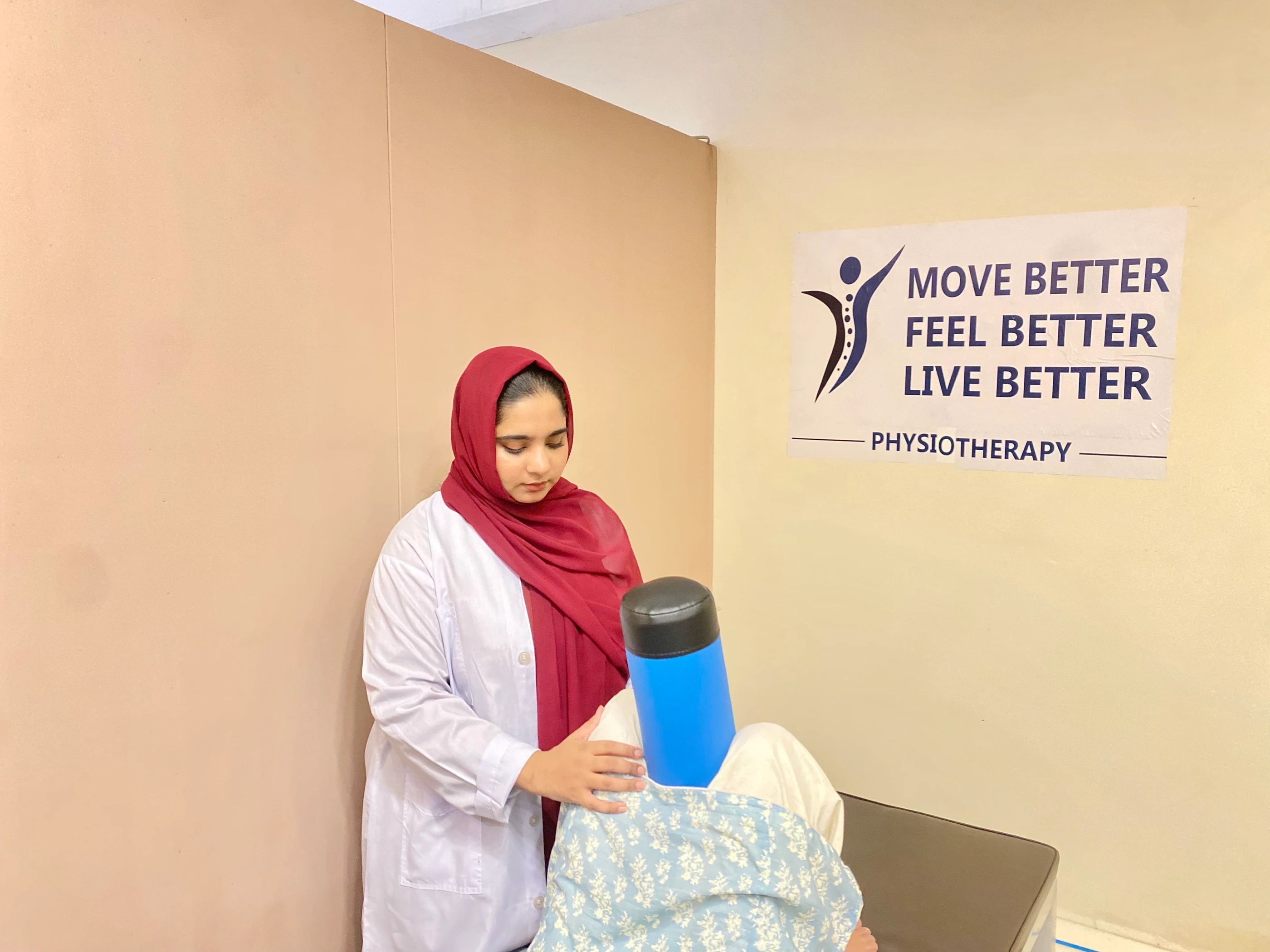
Your first visit is a full 40–45 min with the doctor. We test how the knee moves, how strong the muscles around it are, and what exactly you cannot do any more. You leave that session knowing what is wrong, how many sessions it should take, and what each one costs.
Hands-on treatment
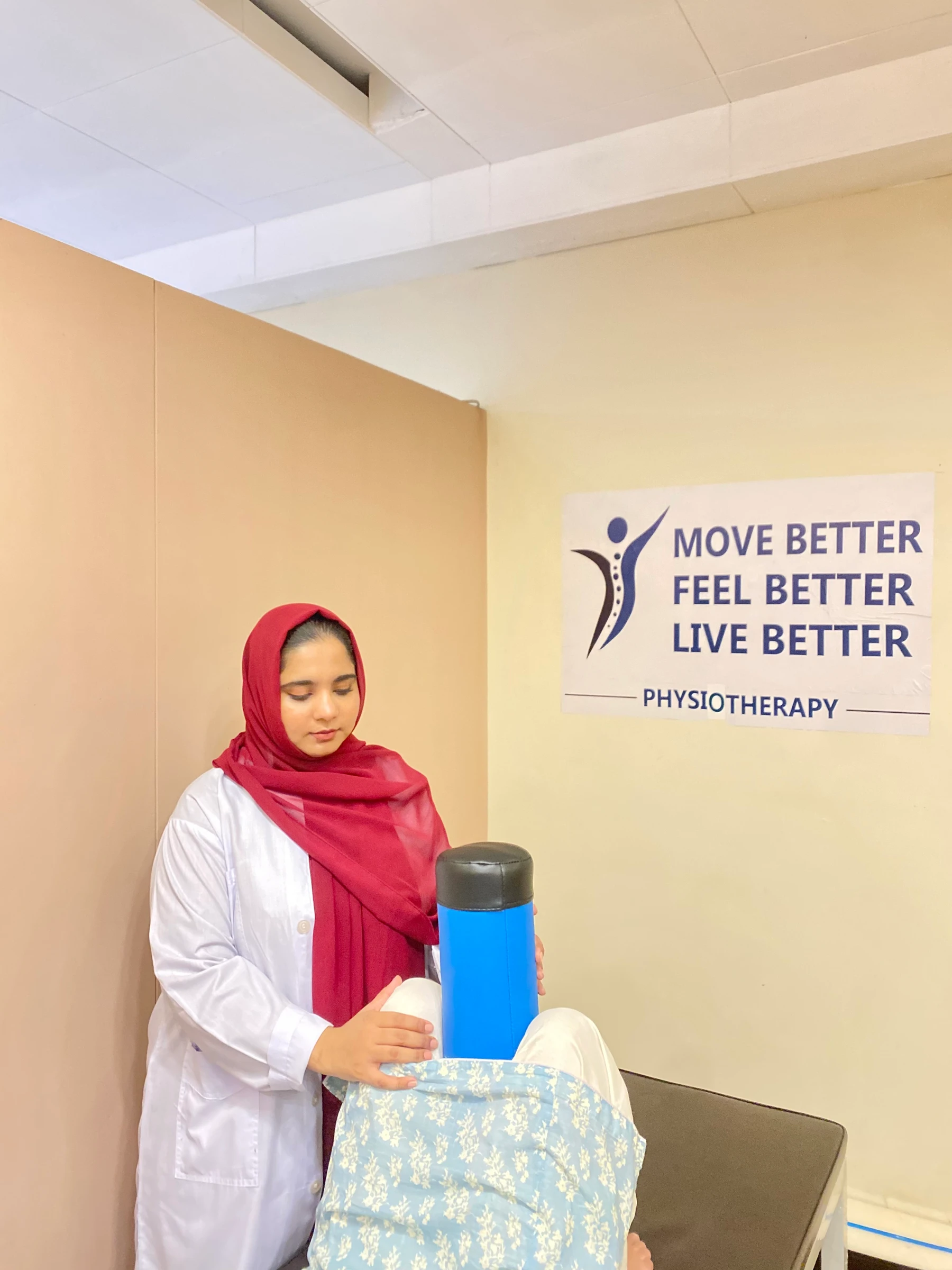
Both doctors are certified manual therapists. The stiffness and guarding around a painful knee are treated by hand first — that is what makes the joint willing to move before you are asked to strengthen it.
Equipment where it earns its place
Therapeutic ultrasound, TENS, EMS, IFT, laser and heat are used to settle pain and inflammation so that the exercise becomes possible. They are used alongside the hands-on work, never instead of it, and never with you left alone in a room.
Strength you keep after you stop coming
The last part of every course is thigh and hip strengthening with thera-bands, and a short programme to do at home. This is the part that decides whether the pain stays away, and it is the part most patients are never given.
See a doctor first if any of these apply.
Physiotherapy is not the right first step for every problem. Call us and we will say so honestly, or go straight to a doctor if:
- The knee locks and will not straighten
- It swelled up within an hour of an injury
- It is hot and red, and you have a fever
- You cannot put any weight on it after a fall
Who will treat you
Both doctors treat this.
Whichever time suits you, you see a Doctor of Physical Therapy who handles this condition every week — not an assistant.
Dr. Maryam Tanveer
DPT, MPhil · Certified Manual Therapist
Dr. Mehwish Warraich
DPT · Certified Manual Therapist and Chiropractor
Questions
Before you book.
Do I need a doctor’s referral?
No. You can book directly. If your assessment shows something that needs a doctor or a scan first, we will tell you that on the first visit rather than starting a course of treatment.
How many sessions will knee pain take?
For the everyday mechanical knee, most patients need 5–7 sessions, and you are reassessed as you go — if you need fewer you stop sooner. Arthritis is different and we would rather you heard it now than at session seven: for early wear, grade 1 and 2, the clinic works at three to four sessions a week for something like twelve to fourteen weeks. That is managed as a programme and reviewed throughout, and there are reduced rates for courses past 7 sessions — ask us and we will work out the cost with you before you commit to it.
I have been told it is arthritis. Can physiotherapy still help?
Physiotherapy does not reverse wear in a joint, and any clinic that tells you otherwise is selling something. What it does is strengthen the muscles that take load off the joint and restore the movement you have lost, which is what changes how the knee feels day to day. It is the longer piece of work, though — three to four sessions a week over about twelve to fourteen weeks for early arthritis, not the five to seven a pulled muscle takes.
Will the treatment hurt?
Hands-on work on a stiff knee can be uncomfortable, but it should never be more than you agreed to. Tell the doctor during the session — the pressure is adjusted to you, not to a protocol.
Ghutnay ka dard — can I be treated in Urdu or Punjabi?
Yes. Both doctors speak Urdu, English and Punjabi.
Can you treat my knee at home?
Yes, across DHA Phase 1, DHA Phase 2, DHA Phase 3 at Rs 3,000 per visit. This is worth asking about if stairs are the problem, or for an elderly patient for whom the journey is harder than the treatment.
Book
Leave your number and we will call you.
Or call 0327 4349159 directly — we are open Mon–Sat 1:00 PM – 10:00 PM · Friday from 3:00 PM.
Also treated here
Other conditions.
Lower Back Pain
Difficulty bending, lifting and walking. Pain and tightness that worsen after sitting for long.
Read more →Sciatica
Sharp, shooting pain travelling from the lower back down the leg, with numbness and tingling in the leg and foot.
Read more →Frozen Shoulder
Shoulder pain that is worse at night, stiffness and restricted movement, difficulty reaching your head or behind your back.
Read more →Neck & Shoulder Pain
Aching in the neck and shoulder, sharp pain on turning or bending the neck, pain moving down the arm, numbness and tingling, muscle spasm and weakness in the arms.
Read more →Sports Injuries
Muscle strain or sprain, swelling and pain around the joint or muscle after a twist or jerk, bruising and tenderness, restricted range of motion.
Read more →Post-Surgery Rehab
Weakness and lost strength after a knee replacement, ACL surgery or a fracture, with muscle tightness and limited flexibility.
Read more →