

Lower back pain treatment in Lahore
kamar dard
Back pain is the single most common reason patients walk into this clinic. Very little of it is a disc that needs surgery. Most of it is a back that has spent years sitting, driving and lifting in ways it was never built for — and that is treatable without an operation.
- First assessment
- Rs 2,500 Follow-up Rs 2,000
- Every session
- 40–45 min One-to-one with a doctor
- Typical course
- 5–7 sessions Packages available over 7 sessions
- Home visits
- Rs 3,000 DHA Phase 1, 2 & 3
Does this sound like you
What lower back pain feels like.
- Pain low in the back, worse after sitting or a long drive
- Stiffness in the morning that takes twenty minutes to ease off
- Pain bending forward to pick something up, or straightening back up
- An ache that spreads into the buttock, or down the back of one leg
- A sudden catch or spasm that stops you mid-movement
- Difficulty standing for prayers, or getting out of a car
What usually causes it
- Mechanical back pain
- The commonest by far. Joints and muscles of the lower back irritated by posture, long hours at a desk or behind the wheel, and lifting badly. It is painful, it is frightening, and it is not damage.
- Disc problems
- A bulge or herniation pressing on a nerve. Typically felt as back pain that travels below the knee, sometimes with pins and needles.
- Lumbar radiculopathy
- Irritation of the nerve root as it leaves the spine. Pain, numbness or weakness following a line down the leg rather than sitting in one spot.
- SI joint dysfunction
- Pain to one side, low down near the belt line. Common after pregnancy and often mistaken for ordinary back pain for years.
- Weak core and hip muscles
- Not a diagnosis on its own, but it is why the pain keeps coming back after it settles. This is the part most patients are never treated for.
You do not need to know which of these it is before you come. Finding that out is what the first assessment is for.
How we treat it
What actually happens, in order.
A full assessment, not a quick look
Your first visit is a full 40–45 min with the doctor. We test how the spine moves, check for nerve signs down the leg, and find out what exactly you can no longer do. If the assessment shows something that needs a scan or a doctor first, you are told that on day one, not on session four.
Hands-on treatment
Both doctors are certified manual therapists. The stiff joints and the muscle spasm guarding them are treated by hand — that is what gets a locked back moving again before anyone asks you to exercise it.
Equipment where it earns its place
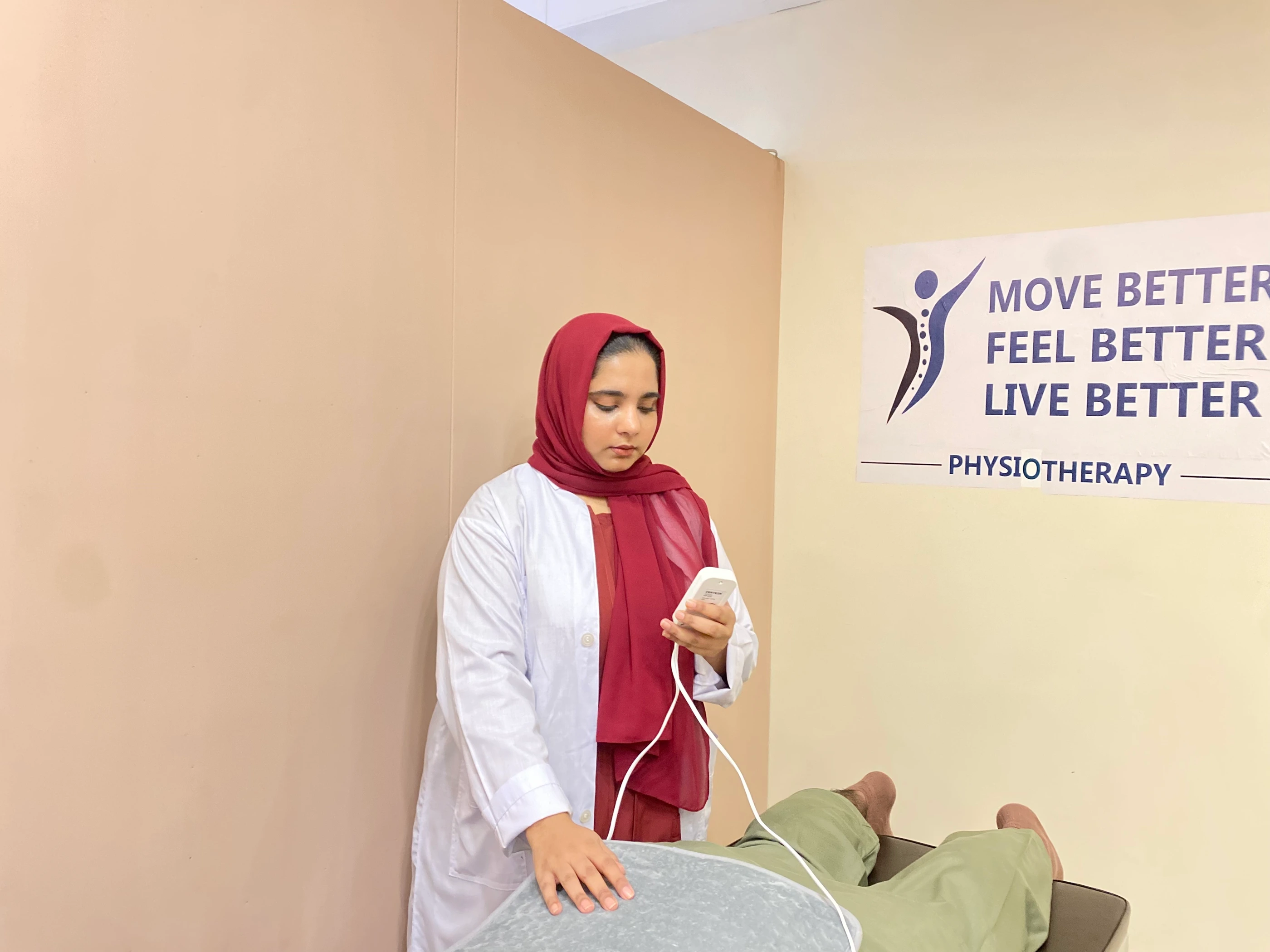
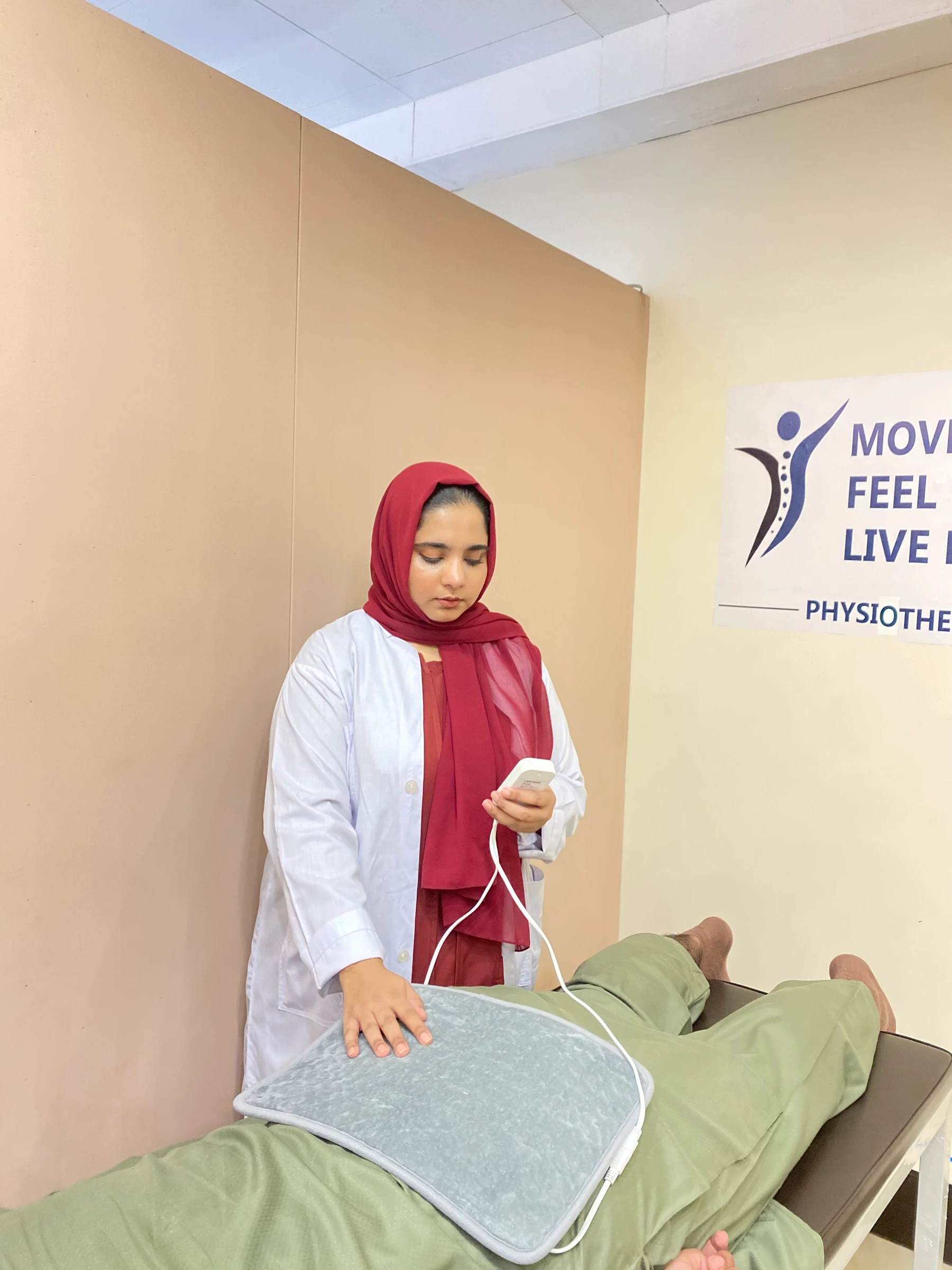
Therapeutic ultrasound, TENS, EMS, IFT, laser, dry cupping and heat are used to settle the pain and the spasm so that movement becomes possible. Alongside the hands-on work, never instead of it.
Strength, and how to sit and lift
Core and hip strengthening with thera-bands, plus the specific fixes for your desk, your car seat and how you pick things up. This is the part that decides whether the pain comes back in six months.
See a doctor first if any of these apply.
Physiotherapy is not the right first step for every problem. Call us and we will say so honestly, or go straight to a doctor if:
- Numbness around the groin or between the legs, or loss of control of your bladder or bowels — this is an emergency, go to a hospital now
- Weakness in the leg or foot that is getting worse
- Back pain that started after a serious fall or road accident
- Fever, unexplained weight loss, or night pain that wakes you from sleep
Who will treat you
Both doctors treat this.
Whichever time suits you, you see a Doctor of Physical Therapy who handles this condition every week — not an assistant.
Dr. Maryam Tanveer
DPT, MPhil · Certified Manual Therapist
Dr. Mehwish Warraich
DPT · Certified Manual Therapist and Chiropractor
Questions
Before you book.
Do I need an MRI before I come?
No, and you do not need a referral either. The assessment tells us whether a scan is needed. Most back pain does not require one, and paying for a scan first often just delays the treatment.
My MRI shows a disc bulge. Does that mean surgery?
Usually not. Disc bulges show up on scans of plenty of people who have no pain at all, so the scan alone does not decide anything — what you can and cannot do does. Surgery is for a small minority, and we will tell you honestly if we think you are in it.
How many sessions will back pain take?
Most patients need 5–7 sessions. You are reassessed as you go, so if you need fewer you stop sooner. Packages are available beyond 7 sessions if a longer course is genuinely needed.
Should I rest in bed until it settles?
No. A day or two of taking it easy is fine, but lying in bed for a week makes back pain worse, not better. Part of the first session is working out what you can safely keep doing.
Is this the same as going to a malishia or a bone-setter?
No. Both doctors hold a Doctor of Physical Therapy degree and a manual therapy certification, and treatment starts with an assessment of what is actually wrong. Forceful pulling or cracking on a back that has not been examined is how people end up worse.
Kamar dard — can I be treated in Urdu or Punjabi?
Yes. Both doctors speak Urdu, English and Punjabi.
Can you treat my back at home?
Yes, across DHA Phase 1, DHA Phase 2, DHA Phase 3 at Rs 3,000 per visit. Worth asking about if sitting in a car is the thing that hurts most, or for an elderly patient for whom the journey is harder than the treatment.
Book
Leave your number and we will call you.
Or call 0327 4349159 directly — we are open Mon–Sat 1:00 PM – 10:00 PM · Friday from 3:00 PM.
Also treated here
Other conditions.
Knee Pain
Morning stiffness, pain on the stairs, tightness after sitting too long, swelling around the knee.
Read more →Sciatica
Sharp, shooting pain travelling from the lower back down the leg, with numbness and tingling in the leg and foot.
Read more →Frozen Shoulder
Shoulder pain that is worse at night, stiffness and restricted movement, difficulty reaching your head or behind your back.
Read more →Neck & Shoulder Pain
Aching in the neck and shoulder, sharp pain on turning or bending the neck, pain moving down the arm, numbness and tingling, muscle spasm and weakness in the arms.
Read more →Sports Injuries
Muscle strain or sprain, swelling and pain around the joint or muscle after a twist or jerk, bruising and tenderness, restricted range of motion.
Read more →Post-Surgery Rehab
Weakness and lost strength after a knee replacement, ACL surgery or a fracture, with muscle tightness and limited flexibility.
Read more →