Children’s physiotherapy and cerebral palsy treatment in Lahore
Bachon ki physiotherapy
Parents usually arrive with one of two sentences. Either another child the same age is already sitting or walking and theirs is not, or a doctor has said cerebral palsy and nobody explained what happens next. Both are worth an assessment, and both are worth it sooner rather than after another six months of waiting to see.
- First assessment
- Rs 2,500 Follow-up Rs 2,000
- Every session
- 40–45 min One-to-one with a doctor
- At home
- Rs 3,000 Same fee across Lahore
- Referral
- Not needed Book directly
Is this you
What parents come in with
- Your child is not sitting, crawling or walking when children the same age are
- A doctor said "delayed milestones" and you were not told what to do about it
- Your child feels stiff to hold, or unusually floppy
- Hands are the difficulty — gripping, holding a spoon, picking up something small
- Your child walks on their toes, or on the side of one foot
- Cerebral palsy has been diagnosed and there has been no regular therapy since
- Your child has autism or Down syndrome and needs work on balance and motor skills
What we work on
- Cerebral palsy
- Most of the clinic’s paediatric work. Physiotherapy does not cure cerebral palsy and nobody honest will tell you otherwise. What it is for is movement, keeping joints from stiffening, and as much independence as the child can reach.
- Delayed motor development
- Head control, rolling, sitting, crawling, standing. When one of them is late the ones after it usually are too, which is why waiting rarely helps.
- Gross and fine motor skills
- The big movements and the small ones. Hand strength, grip and release, moving something from one hand to the other, and the everyday things those add up to — a spoon, a button, a pencil.
- Balance and coordination
- Postural control is what sitting, standing and walking are built on, so it is worked on directly rather than hoped for. Activities are chosen to improve balance and the way a child walks.
- Autism and Down syndrome
- Both treated here, confirmed by the clinic. Physiotherapy is not aimed at the condition itself. It is aimed at the movement side of it — muscle tone, balance, coordination, and the motor skills that school and the rest of a child’s therapy depend on.
You do not need to work out which of these it is before you come. That is what the first assessment is for.
How it works
What actually happens, in order.
The first session is mostly watching
What the child does on their own, unprompted, before anyone asks them to perform. And listening to the parent, who has more information about this child than any test in the room.
Sessions built around what the child can manage
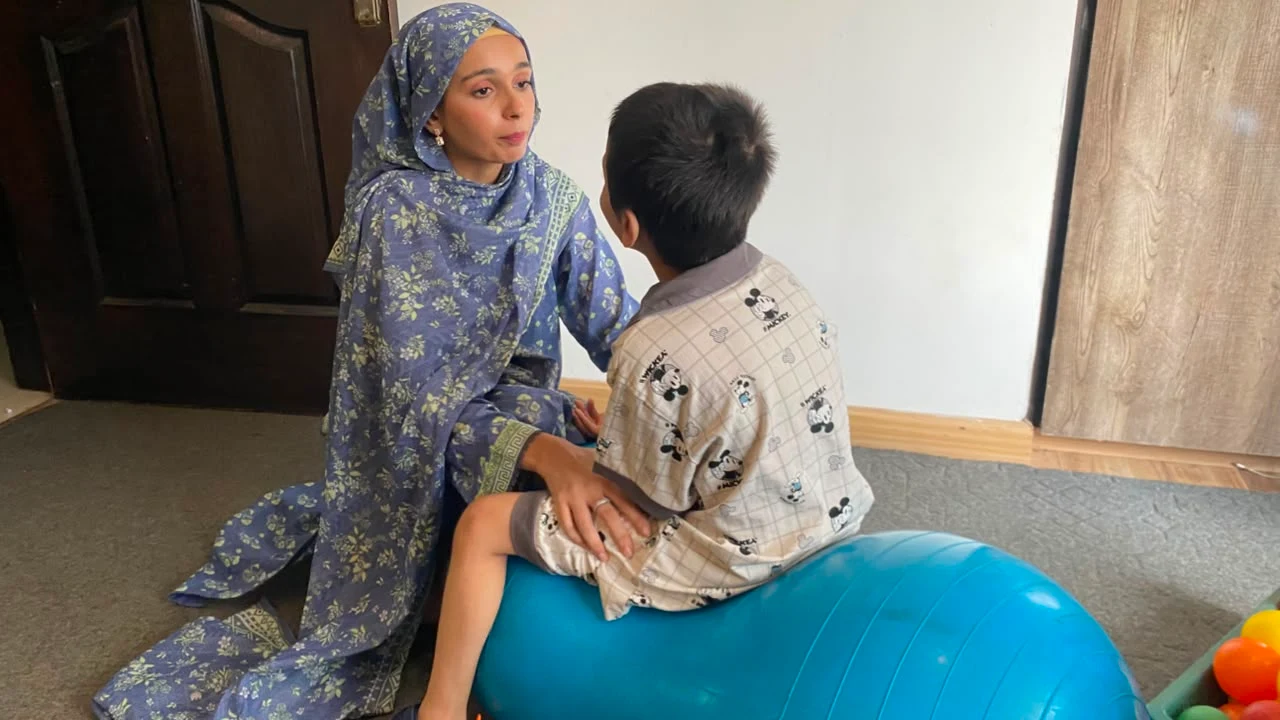
Not around a protocol. A session that ends in tears teaches nothing and the child remembers it next week, so the work is paced to the child in front of us.
The parent is taught the home programme
This is the part that actually changes things. Forty-five minutes a week does not move a child’s development; what happens on the other six days does, and you leave knowing exactly what to do.
Reviewed as you go
Children change, and a programme set in January is not the right one in June. Progress is looked at again rather than assumed, and the plan changes with it.
Some things need a doctor before a physiotherapist.
Call us and we will tell you honestly, or go straight to your paediatrician if:
- Your child has lost a skill they already had
- There have been fits or seizures that a doctor has not seen
- Your child is unwell, feverish, or not feeding properly
- There is any difficulty with breathing
- The problem started after a fall or an injury
- A limb is hot or swollen, or the child will not let you touch it
Who will treat you
Both doctors treat this.
Whichever time suits you, you see a Doctor of Physical Therapy who treats this — not an assistant. The clinic is open Mon–Sat 1:00 PM – 10:00 PM · Friday from 3:00 PM.
Dr. Maryam Tanveer
DPT, MPhil · Certified Manual Therapist
Dr. Mehwish Warraich
DPT · Certified Manual Therapist and Chiropractor
Questions
Before you book.
Is my child too young to be assessed?
No age is too early for an assessment. Call, tell us how old your child is and what is worrying you, and we will tell you whether it is worth coming in.
Will physiotherapy cure cerebral palsy?
No. Cerebral palsy is not something physiotherapy cures, and a clinic that promises you it will is one to walk away from. What regular therapy is for is movement, stopping joints from stiffening, and independence in the ordinary things.
How long is a session for a small child?
Sessions are 40–45 min, and we use as much of that as the child can actually use. Some days that is all of it and some days it is not, and pushing past the point where a child has had enough is wasted time.
Can you treat my child at home?
Yes. A home visit is Rs 3,000, and it is the same fee anywhere in Lahore — not only the phases next to the clinic. For a full programme the clinic is the better place — it is equipped for this work in a way a house is not. But if the journey is the hardest part of the appointment, which with cerebral palsy it often is, say so and we will come to you rather than have you miss the sessions.
Can I stay in the room during the session?
Yes. Parents stay, and with a small child it usually goes better that way. You are also the one being taught the home programme, so there is a reason for you to be in the room rather than outside it.
Do you treat children with autism or Down syndrome?
Yes. What physiotherapy works on in both cases is the movement side — muscle tone, balance, coordination and motor skills — rather than the condition itself. If your child is already seeing a speech or behavioural therapist, this works alongside that rather than instead of it.
How many sessions will my child need?
For the everyday muscle and joint work the clinic does most, a course is usually 5–7 sessions. This is not that. It is reviewed as you go, and after the first assessment we will tell you what we think rather than sell you a number on day one.
What does it cost?
The first assessment is Rs 2,500 and every session after it is Rs 2,000. Sessions run 40–45 min, one-to-one with a doctor. Ultrasound, TENS and the rest of the equipment are not charged on top.
Book
Leave your number and we will call you.
Or call 0327 4349159 directly — we are open Mon–Sat 1:00 PM – 10:00 PM · Friday from 3:00 PM.
Also treated here
Other specialist care.
Women's health physiotherapy
Pelvic floor muscle strengthening, poor core strength, urinary incontinence, and pain and stiffness in the lower back after a C-section. Treated by a female physiotherapist, in a private treatment room.
Explore women's health →Stroke rehabilitation
Poor balance and coordination after a stroke, muscle spasticity, reduced hand and arm function, and joint contractures. Available at the clinic, or at home across DHA Phase 1, 2 and 3 if travelling is difficult.
Explore stroke rehab →Everyday aches and injuries
Knee Pain, Lower Back Pain, Sciatica, Frozen Shoulder and the rest of the work both doctors do every week.
All conditions →